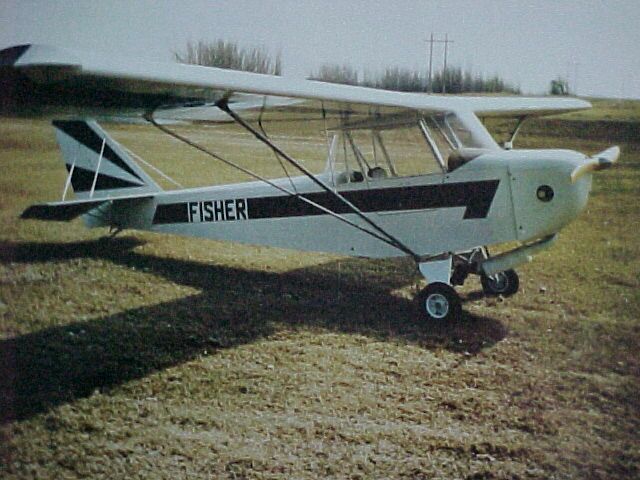
While I prepare for the paper ordeal that preceedes being allowed to build the plane I really want under the "experimental" rules, I might as well build something else, so I set out to find a plane that can be built under the much less restrictive Ultra Light Airplane (UL) rules.
I initially bought plans for another UL, the RW6 Parasol, but they were just too plain lousy. It took me quite a while to locate another construction that had the same appeal to me. I have finally set my eyes on a FP-606 from Fisher Flying Products, which is a replica of the Cessna 150/152 that can be built with either conventional grear or with a nose wheel. I prefer the former.
As the FP-606, like most of their products, is constructed of wood and fabric, I should be able to keep the investment minimal and spread it out, except for the engine, where I probably will use the recommended Rotax 277. The second largest investment will be the covering, where I intend to use the Stits' Poly-fiber process for reasons of safety (it won't burn) and longevity.
| RW6 "Parasol" statistics | ||
| Top speed | 105 | km/h |
| Cruise speed | 89-97 | km/h |
| Vne | 145 | km/h |
| Range | 241 | km |
| Stall speed | 42 | km/h |
| Rate of climb | 3.6-4 | m/s |
| Takeoff run | 46 | m |
| Landing run | 46 | m |
| Service ceiling | ? | m |
| Engine used | Rtx277 | HP |
| Engine range | 28-52 | HP |
| Fuel capacity | 19-26 | l |
| Empty weight | 114 | kg |
| Gross weight | 227 | kg |
| Height | 1.80 | m |
| Length | 5.41 | m |
| Wing span | 8.79 | m |
| Wing area | 10.78 | m² |
| Wing loading | 21 | kg/m² |
The plane easily classifies as an ultra light, even within the Danish regulations, which should cut the red tape about construction to a minimum. If I build this plane, supervision of the project will be handled by DULFU (Dansk UltraLet Flyver Union) and the project would be required to go through periodic inspections and a static load test.
 ping@piteraq.dk
| Back to previous page | Back to Ping's Homepage |
